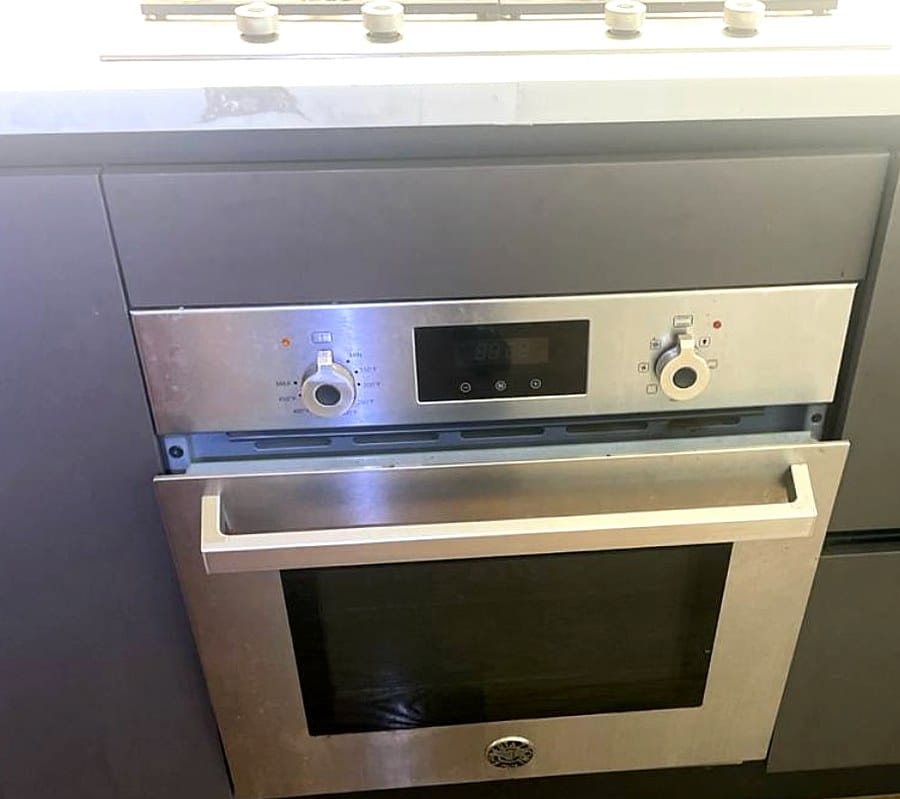
An oven that will not heat may have an incorrect setting, a power-supply problem, a failed electric element or gas ignition component, or a sensor or control fault. Slow preheating and. uneven baking are different symptoms from an oven that remains completely cold.
Start by identifying the oven’s fuel type, selected mode, and exact symptoms. This guide covers household ovens in NYC homes and apartments, not restaurant cooking equipment. Basic checks should stay outside gas connections, wiring, and concealed components.
Safety First Gas Odor, Smoke, or Electrical Damage
If you smell gas or suspect a leak, leave immediately and take others with you. Do not operate switches, unplug the oven, use a phone nearby, or search for the leak. From a safe location, call 911 or your gas utility. Do not return until responders say it is safe.
For a fire, dangerous smoke or fumes, or another immediate threat, move to safety and call 911 rather than waiting for an appliance appointment. Stop using equipment with sparking, damaged wiring, or repeated breaker trips. Do not approach it to test another mode.
Why Is My Oven Not Heating?
Possible causes include operating settings, an interrupted supply, electric bake or broil elements, gas ignition, temperature sensing, door closure, wiring, or safety and control components. These are possibilities, not a parts diagnosis. A working display does not establish that the heating system has the power or commands it needs.
1. Check the Oven Settings and Operating Mode
Confirm the intended cavity and cooking mode, select a temperature, and make sure the cooking program has actually started. Check for a delayed start, control lock, demonstration mode, or an incomplete previous cycle. Whirlpool identifies Demo Mode and Delayed Start as possible explanations for an oven that powers on without heating.
Sabbath Mode is not simply another name for Demo Mode. On the Whirlpool ovens described in its guidance, it keeps Bake operating while changing other functions and display responses. Read the exact model instructions before interpreting an unfamiliar symbol or apparently unresponsive control.
2. Electric Oven Not Heating: Possible Bake Element Problems
Depending on the design, an electric oven uses bake, broil, and sometimes convection elements. The bake element may be concealed. Record whether Bake, Broil, or both are affected; visible damage is useful information, but do not touch, lift, or remove an element.
An element need not glow continuously to be working. GE explains that elements cycle and that a broil element may heat without visibly glowing in certain operating conditions. Lack of glow alone is not proof of failure.
Power also matters. Many full-size electric ranges use a rated 208/240-volt supply, and partial power can leave the clock working without normal heating. Use the model’s electrical specifications; do not test live terminals, remove covers, or pull out the range. A technician or electrician should investigate the supply and heating circuits.
3. Gas Oven Not Heating: Possible Igniter Problems
A gas oven that remains cold, repeatedly fails to light, or takes much longer than usual to warm up may have an ignition fault. The possibilities include an igniter, gas valve, control, wiring, or another model-specific component. Not every gas oven uses the same ignition arrangement.
If the cooktop burners already work normally but the oven does not, record that distinction. It does not rule out an oven-specific supply or ignition problem; GE discusses this exact symptom in its guidance. Do not light other burners as a test when a gas leak is suspected.
Do not remove the oven floor or burner cover, manually light the oven, adjust a gas valve, or keep trying to restart failed ignition. Report repeated unsuccessful ignition or a new bang or delayed-lighting symptom to a qualified technician. Gas odor takes priority over troubleshooting: follow the emergency directions at the beginning of this guide.
4. A Temperature Sensor May Be Providing Incorrect Readings
Many electronically controlled ovens use a sensor to report cavity temperature; other designs regulate temperature differently. Inaccurate sensing or a control fault can contribute to overheating, underheating, or inconsistent cooking. However, a difference between the selected temperature and one thermometer reading does not prove that the sensor has failed.
Gas and electric ovens normally cycle heat on and off, so the temperature rises and falls around the selected setting. GE also notes that measurements depend on location and door openings. Judge performance using the manufacturer’s assessment procedure, not an instant reading taken after opening the door.
Record the cooking mode, selected temperature, preheat completion, rack position, and recurring results. A technician can compare the sensor and control behavior with model specifications. Do not use an arbitrary calibration offset to disguise a sudden loss of heating or a recurring fault.
5. Check Whether the Oven Door Closes Properly
A damaged gasket, misaligned hinge, displaced rack, or obstruction can allow heat to escape. With the oven off and fully cool, check whether racks and cookware prevent normal closure and look for visible damage. Do not force the door, bend hinges, or modify its latch.
A poor seal is especially relevant to heat loss and cooking consistency; it is not an automatic explanation for every completely cold oven. Some designs also use door sensing to change operation. Report the actual closure problem rather than assuming the gasket is the only fault.
Do not treat the oven gasket like a washable refrigerator seal. GE warns that woven fiberglass oven gaskets can be damaged by cleaning or wetting. Clean only the surrounding surfaces and components allowed by your owner’s manual, and do not rub, soak, or pull the gasket unless the model specifically permits that maintenance.
6. Oven Takes Too Long to Preheat
Preheat time varies with oven design, selected temperature, starting temperature, racks, and electrical installation. GE lists different expectations for visible and hidden bake elements and notes that a suitable 208- volt installation can preheat more slowly than a 240-volt one. A longer time is not automatically a failed element.
Compare with the exact model’s instructions and its previous performance. Record the time, mode, target temperature, racks or accessories inside, and whether the door was opened repeatedly. A new persistent delay can still involve an element or circuit fault, gas ignition, sensing, a poor seal, or controls. Do not substitute Broil for Bake or start Self-Clean as a heating test.
7. Oven Heats Unevenly or Does Not Maintain Temperature
First review rack placement, cookware, loading, preheating, and the selected recipe mode. Do not block vents or cover the cavity floor with foil or liners unless the manual expressly allows it. Distinguish repeated uneven cooking from the normal temperature cycling explained above.
On convection models, a silent fan with the door open does not necessarily mean failure. Whirlpool describes door-related fan stopping and model-dependent operation during preheat and non-convection cycles. Do not hold or bypass a door switch to test it.
If ordinary loads still cook unevenly with correct settings, record which side or mode is affected. A technician may need to check the fan, elements, sensor, door, and controls. Persistent poor performance should not be dismissed simply because the oven produces some heat.
8. The Oven Display Shows an Error Code
Record the complete code, including letters and spaces, before any permitted reset. Note whether it appeared at startup, while heating, during cleaning, or while idle, and photograph the model label if it is safely accessible.
Codes can relate to sensing, locks, heating, wiring, or controls, but meanings depend on the brand and model. Use the correct manual rather than a generic code list. A code can identify a circuit or condition without proving which part needs replacement. Do not remove the panel or reset internal protection devices. If a permitted user-level restart does not resolve the fault, arrange service.
9. Oven Stopped Working After a Self-Cleaning Cycle
High-temperature self-cleaning is different from Steam Clean. Do not apply one process’s instructions to the other. During high-temperature cleaning, the door normally locks and may stay locked while the oven cools; this alone does not establish a breakdown. GE documents that cooling requirement. [12] Whirlpool describes Steam Clean separately.
After the normal cooldown, persistent loss of heat, a returning code, or a door that will not release may require diagnosis of the lock, temperature sensing, thermal protection, heating circuit, or controls. A thermal safety device tripping is not the routine purpose of a cleaning cycle.
The timing does not prove which part failed or that self-cleaning caused the fault. Do not force the door, bypass the lock, or run repeated cleaning cycles as a generic repair. Use only the exact model’s approved procedure and arrange service when the problem persists.
Quick Troubleshooting Table
| Symptom | Possible explanation | Safe next step |
|---|---|---|
| Electric oven stays cold | Settings, supply, element, or control fault | Confirm the mode; record which functions fail. |
| Gas oven does not ignite | Ignition, supply, valve, or control issue | Stop repeated attempts; request diagnosis. |
| Oven heats slowly | Design or setup, heat source, seal, or supply | Compare with the manual and prior behavior. |
| Oven cooks unevenly | Loading, fan, element, airflow, or sensing | Check normal rack placement and cookware. |
| Oven seems too hot or cool | Normal cycling, measurement, sensor, or control | Record the mode and pattern, not one reading. |
| Oven door will not close | Obstruction, gasket, hinge, or latch | Inspect visible conditions when fully cool. |
| Error code appears | Model-specific fault or operating condition | Photograph the exact code and model label. |
| Failure after self-cleaning | Cooldown lock, lock fault, protection, or controls | Allow normal cooling; follow the exact manual. |
These are possible explanations, not confirmed diagnoses. Gas odor, fire, dangerous smoke, sparking, or other immediate hazards override this table.
What Can Homeowners Safely Check Before Calling for Repair?
With no emergency warnings, confirm the mode, temperature, and whether cooking started. Record affected functions, codes, timing, and recent cleaning, installation, or power interruptions. Inspect only visible, cool surfaces without removing covers.
Use only the owner’s permitted supply checks at a safely accessible, dry electrical panel. Do not remove covers or repeatedly reset a tripping breaker. A lit display does not make internal work safe. Do not disconnect gas lines or manually ignite the oven.
For an NYC apartment or condo, explain building-access restrictions and coordinate with management when required. Identify a built-in installation. Do not pull out a range, remove an anti-tip restraint, or dismantle cabinetry to find a model number.
When Should You Call for Residential Oven Repair in NYC?
Arrange service if the oven stays cold after settings are confirmed, ignition repeatedly fails, an element appears damaged, heating becomes persistently unreliable, the door will not close, or an error returns. A continuing problem after the normal cleaning cooldown also needs attention.
Suspected gas leakage, fire, or dangerous smoke requires the emergency response described above, not a routine appointment. An electrician or building maintenance may be needed for a fault in the property’s electrical supply.
How to Help Prevent Residential Oven Problems
Follow the model’s cleaning instructions, manage spills only after safe cooling, use suitable cookware, leave intended vents clear, and keep racks from obstructing the door. Inspect the gasket without automatically washing it. Do not use self-cleaning as a repair procedure for a malfunctioning oven.
Report a change in preheat time, recurring codes, door alignment, or cooking results. Routine care can help identify problems, but it cannot prevent every component failure. Never bypass protection devices or keep using an oven with an unresolved safety concern.
Frequently Asked Questions
Why is my electric oven not heating?
Check the cooking program, temperature, and special settings first. Possible faults involve the electrical supply, bake or broil element, sensor, wiring, or controls. A working display does not prove that the heating circuit has correct power. Record which modes fail instead of selecting a replacement part from the symptom alone.
Why is my gas oven not heating?
The cause may involve ignition, the oven’s gas supply path, a valve, wiring, or controls. Working cooktop burners do not establish that the oven system works. Do not manually light the oven or adjust internal gas components. For suspected gas leakage, leave immediately and call for emergency help from a safe place.
Why does my oven turn on but not get hot?
Controls can power on while heating is prevented by Demo Mode, a delayed start, an incomplete command, a supply problem, or a component fault. Follow the exact model’s operating checks. A lit control panel is not a complete electrical or heating-system test.
Why is my oven taking so long to preheat?
Normal timing depends on the oven, target temperature, starting conditions, racks, and supply. A marked change from previous performance can indicate an ignition, element, supply, sealing, sensor, or control problem. Compare similar conditions rather than applying a universal preheat deadline.
Can a broken oven door seal prevent proper heating?
A damaged seal or door that does not close correctly can let heat escape and affect cooking. It does not explain every no-heat fault. Check for visible obstructions when the oven is cool, and follow the manual’s gasket-care restrictions rather than scrubbing or soaking the seal.
Is it safe to use an oven that heats unevenly?
Uneven browning may reflect loading or the selected mode, but repeated unexplained poor heating needs inspection. Do not rely on a malfunctioning oven to cook predictably. Stop use for gas odor, smoke, sparking, overheating, or electrical damage, and follow the appropriate emergency guidance rather than testing more cycles.
When should I replace my oven instead of repairing it?
Compare the diagnosis and repair estimate with the appliance’s condition, age, parts availability, and history. For a built-in oven, also consider replacement dimensions, installation work, and compatibility with existing utilities. There is no universal age or repair-price percentage that makes the decision for every household.
Residential Oven Repair in NYC
Screws Appliance Repair provides residential appliance service in New York City. If your oven remains cold, repeatedly fails to ignite, preheats unusually slowly, or produces inconsistent cooking results, request oven and stove repair in NYC for model-specific diagnosis.
Provide the brand, model, fuel type, affected cooking mode, displayed code, and when the problem started. Include photos of the display or accessible model label and mention building-access requirements. This helps the team prepare without guessing which part has failed.
Keep checks at the owner-maintenance level. A suspected gas leak or fire requires emergency assistance, not a routine repair booking.