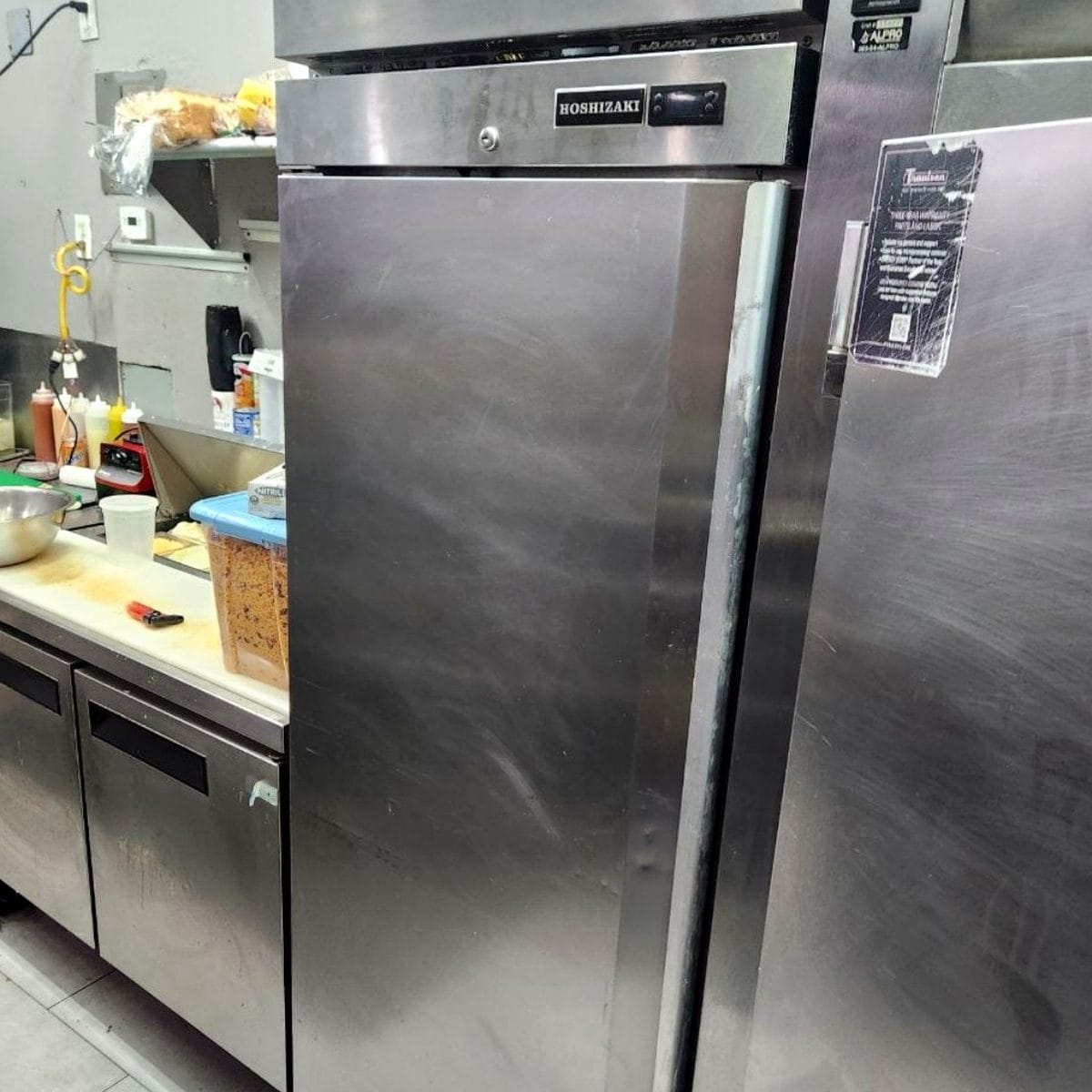
A commercial refrigerator that is not cooling may have a door-seal problem, blocked airflow, a dirty condenser, evaporator icing, a fan fault, or a problem with its controls, power supply, compressor, or refrigerant circuit. Start by protecting food and checking accessible operating conditions—not by assuming the compressor needs replacement.
This guide is for managers and staff in New York City restaurants, bars, delis, and food-service kitchens. It covers reach-in and other commercial refrigerated cabinets. Equipment designs vary, so use the operator manual for the exact model before cleaning, resetting, or adjusting anything.
First, Protect the Food
NYC generally requires time/temperature control for safety (TCS) foods to be cold-held at 41°F (5°C) or below. Specific exceptions and product rules apply; this is not a universal thermostat setting for every refrigerator or every food.
Check representative food items with a clean, sanitized, calibrated food-probe thermometer. Record the readings, time, and last known safe check. A controller display or cabinet-air reading alone does not establish the temperature history of the food.
When the unit cannot maintain required conditions, stop adding food, move still-safe stock to suitable working refrigeration, and separate affected items from service. The person responsible for food safety must evaluate them under the establishment’s procedures and applicable NYC requirements. Do not serve food whose safety cannot be established
What “Not Cooling” Actually Means
Describe the pattern: the unit runs but stays warm, does not start, cools intermittently, warms during busy
service, or reports a recurring alarm. A combined refrigerator/freezer may have a problem in only one
section; do not assume its sections share one cooling system.
Record both displayed and measured temperatures. Note recent loading, open doors, cleaning, power
interruptions, and whether the event coincides with defrost. Brief air-temperature changes and sustained
loss of food-temperature control are different problems.
For a unit that cools but repeatedly swings in temperature, see our guide to commercial refrigerator
temperature fluctuations.
Common Causes of a Commercial Refrigerator Not Cooling
1. Door Not Sealing Properly
A torn gasket, dirty sealing surface, misaligned hinge, or failed closer can let warm kitchen air enter the cabinet. A pan, shelf, or container may also prevent the door from closing. The unit may run longer without recovering temperature.
What staff can check: Look for visible gaps, clean accessible gasket surfaces according to the manual, and remove anything obstructing closure. Note whether the door sags or fails to close on its own where a self-closing mechanism is fitted.
Do not force hinges or adjust a closer without the appropriate procedure. A door sweep belongs to some walk-in designs; it is not a standard component to look for on every reach-in refrigerator.
2. Blocked Airflow or an Internal Fan Problem
Boxes pressed against air outlets, overloaded shelves, misplaced pans, or ice around the evaporator can interrupt the flow of cold air. A fan or its control circuit can also fail. These conditions may leave some areas cold while product elsewhere warms.
What staff can check: Reposition stock away from vents and restore the manufacturer’s loading arrangement. On prep tables, use the specified pans and covers. Confirm that recent restocking has not obstructed an air path or exceeded the equipment’s intended use.
A silent fan during one observation is not proof of failure. Depending on the model, evaporator fans may stop with an open door or cycle with the compressor. Record when the fan is silent; do not bypass a door switch or reach behind a guard. TRUE explicitly describes model-dependent fan operation.
3. Dirty Condenser Coils or Restricted Condenser Airflow
The condenser releases heat removed from the cabinet. Dust, lint, grease, blocked grilles, or a condenser fan fault can prevent adequate heat rejection. A clear interior will not compensate for a restricted condenser.
What staff can check: Look at accessible exterior grilles and check for items stored in front of them. Only clean the coil when the exact manual identifies it as an operator task, and first isolate power using the approved, safely accessible procedure. The controller’s OFF setting may not isolate all electrical components.
Light surface dust is different from a grease-packed coil. Beverage-Air directs greasy-coil cleaning to an experienced technician. Do not spray electrical components, use a pressure washer, or pull out built-in or hard-wired equipment to reach the condenser.
4. Evaporator Icing or a Defrost-System Problem
Heavy ice can block the evaporator and reduce airflow into the cabinet. Possible contributors include excessive moisture entering through the door, restricted airflow, a blocked defrost drain, fan problems, or a fault in the model’s defrost control or termination system.
Do not assume every commercial cooler has an electric defrost heater. Some use off-cycle defrost, with cooling paused rather than a heater energized; other equipment uses different arrangements. TRUE’s guide distinguishes off-cycle refrigerator operation from heated freezer defrost.
What staff can check: Photograph visible ice without removing protective covers. Record whether the problem follows defrost, whether water appears in the cabinet, and whether the door has been left open. Do not chip ice, use a heat gun, or force a blocked drain clear.
Temporary improvement after ice melts does not establish the underlying cause. For accompanying water problems, see commercial refrigerator leaks and possible sources.
5. Refrigerant Leak or Sealed-System Restriction
Loss of refrigerant can reduce cooling capacity. A restricted capillary tube, expansion device, or other part of the circuit can also limit performance—but a restriction is not the same diagnosis as a low charge.
Long run times, partial coil frost, unusual sounds, or oily residue can be useful observations. None confirms a leak or tells staff how much refrigerant is in the system. Normal refrigerant flow can also make noise, and a hot compressor is not a diagnosis by itself.
What staff can do: Photograph an accessible nameplate and describe the symptoms. Do not attach gauges, open lines, add refrigerant, or purchase a “top-up” as a substitute for diagnosis. Refrigerant work belongs to a technician qualified for the equipment and refrigerant, with any required certification.
Some commercial refrigerators use R290, a flammable refrigerant identified on the equipment label. TRUE notes that it has no added odorant, so smell cannot establish that a leak is absent. Suspected circuit damage requires appropriate service procedures—not a DIY leak test.
6. Thermostat, Controller, or Temperature-Sensor Fault
A misplaced or inaccurate probe, thermostat problem, controller fault, or wiring issue can prevent normal cooling or misrepresent conditions. A displayed number may be a setpoint, a sensor reading, or a defrost related indication; check the manual before treating it as a food-temperature reading.
What staff can check: Record the setting, actual display, alarm, and independent measurements. Different sensor locations and response times can produce different readings without proving a fault. Do not change hidden calibration, compressor-delay, or defrost parameters to make the display look correct.
Error codes and operating messages are model-specific. Photograph them before a reset and let the technician interpret them with the correct documentation.
7. Compressor or Start-Component Problem
A compressor that fails to start or cannot provide adequate pumping may leave the cabinet warm. Depending on the design, the fault may involve a start relay, capacitor, overload, electrical supply, controller, or the compressor itself.
Repeated clicking or an attempted start followed by silence is important to report, but it is not enough to select a replacement part. A technician must distinguish a compressor fault from problems in its supply and control circuits.
What staff can do: Record the sounds, alarms, and timing from a safe position. Do not touch the compressor or hot tubing to “test” temperature.
Do not open the electrical compartment, replace start components, or bypass an overload.
8. Power or Electrical-Supply Problem
Lights and a display can work even when another circuit or component is not operating correctly. Power faults may include a disconnected supply, damaged cord, tripped protective device, voltage problem, fuse fault, or internal wiring issue.
What staff can check: Visually confirm that an accessible plug is properly connected only when the area is dry and the cord and outlet appear undamaged. Report a tripped breaker or GFCI to the responsible person. Do not repeatedly reset protection, test live outlets, replace fuses, or open a panel as part of this checklist.
Do not substitute an extension cord, adapter, or improvised power connection. Follow the model’s supply requirements. Beverage-Air’s reach-in instructions specify the required electrical arrangement and prohibit extension cords.
9. High Ambient Kitchen Temperature
A unit beside ovens or fryers, exposed to direct heat, or surrounded by poor ventilation may operate outside its intended conditions. Restricted condenser space can make the problem worse during a busy service period.
What staff can check: Remove stored items blocking exterior ventilation, note nearby heat sources, and record whether performance improves outside peak hours. Compare the installation with the exact model’s clearance and ambient-temperature requirements; do not apply one generic spacing rule to every refrigerator.
Changing a thermostat to its coldest setting is not a substitute for correcting excessive heat load or an unsuitable installation.
10. A Problem After Cleaning, Moving, or Service
Cooling can change after stock is rearranged, a grille is blocked, a door is disturbed, controls are changed, or the unit is moved. A service-related connection, component, or adjustment problem is also possible, but timing alone does not prove who caused the fault.
What staff can check: Document what changed, when it changed, and the last known normal operation. Contact the service provider with the display photo and model details when the issue follows a visit. Do not reopen panels to look for disconnected wiring.
Allow only the stabilization time appropriate to the model and circumstances. Recovery time is not permission to leave food in unsafe conditions; protect inventory while the cause is being established.
What Restaurant Staff Can Safely Check
Use this short handoff record after taking the food-protection actions described earlier. It helps separate an operating issue from a repair that requires tools and access to internal components.
Temperatures and timing
Record the displayed reading, measured food temperatures, time discovered, and last normal check. Note whether the issue appears during startup, busy service, restocking, defrost, or overnight.
Equipment identification
Photograph the manufacturer, model, serial number, refrigerant designation, and any error message when the label and display are safely accessible. Identify which cabinet or section is affected.
Visible operating conditions
Check door closure, gasket condition, shelf and pan placement, unobstructed air openings, and visible ice or water. Observe sounds without touching machinery or defeating safety switches.
Recent changes and access
Report cleaning, loading, relocation, power interruptions, and previous work. Tell the dispatcher about built in equipment, tight working space, loading access, building approvals, or restrictions on moving the unit.
Reset history
If the operator manual permits a restart and no hazard is present, follow that procedure once. Record the result. Repeated resets can delay diagnosis; a returning fault needs investigation.
When to Stop Food Storage—and When to Shut Off Power
These are two different decisions. Taking a refrigerator out of food-storage service does not automatically mean operating an electrical switch or pulling its plug.
Stop relying on the cabinet for cold holding
Do this when food temperatures cannot be controlled, the unit stays warm, or recurring faults make storage unreliable. Protect inventory, restrict use of the affected cabinet, and arrange diagnosis. Resume normal storage only after temperature control has been verified under appropriate conditions.
Treat electrical, mechanical, or leak hazards separately
Burning insulation, smoke, sparking, repeated breaker trips, damaged wiring, or water reaching electrical components require immediate attention. Keep staff away. Arrange safe isolation by a responsible, authorized person; do not touch wet plugs or panels.
For a suspected active flammable-refrigerant release, avoid flames and actions that could create sparks near the equipment. Move away and follow the site’s emergency procedure. Contact emergency services for fire or an immediate danger, and a qualified refrigeration technician for equipment diagnosis.
Frequently Asked Questions
Why is my commercial refrigerator running but not cooling?
Possible causes include air leaks, blocked airflow, a dirty condenser, fan failure, evaporator ice, an unsuitable heat load, or a sealed-system or compressor fault. Running does not prove that cooling capacity or food temperatures are acceptable.
Does ice on the evaporator mean the refrigerator needs refrigerant?
No. Ice can have several causes, including moisture entering the cabinet, airflow problems, or a defrost issue. The frost pattern is useful information for the technician, not a basis for adding refrigerant.
Can I keep using the unit if the display looks normal?
Only rely on it when actual storage conditions meet the requirements for the food and equipment. A normal looking display cannot establish that product temperatures have stayed safe. Use the measurement and food-protection steps in this guide.
Commercial Refrigerator Repair in NYC
Screws Appliance Repair provides commercial refrigerator repair in New York City for equipment such as
reach-in refrigerators, prep tables, undercounter units, display cases, and back-bar coolers.
When requesting diagnostics, send the model and serial number, display or alarm photo, measured
temperatures, when the problem started, and the checks already completed. Include any site-access
restrictions. This gives the service team useful information without requiring restaurant staff to open the
equipment.
If basic operator checks do not restore dependable cooling, arrange professional diagnosis rather than
continuing to reset the controller. Protect food while the equipment is being assessed.