
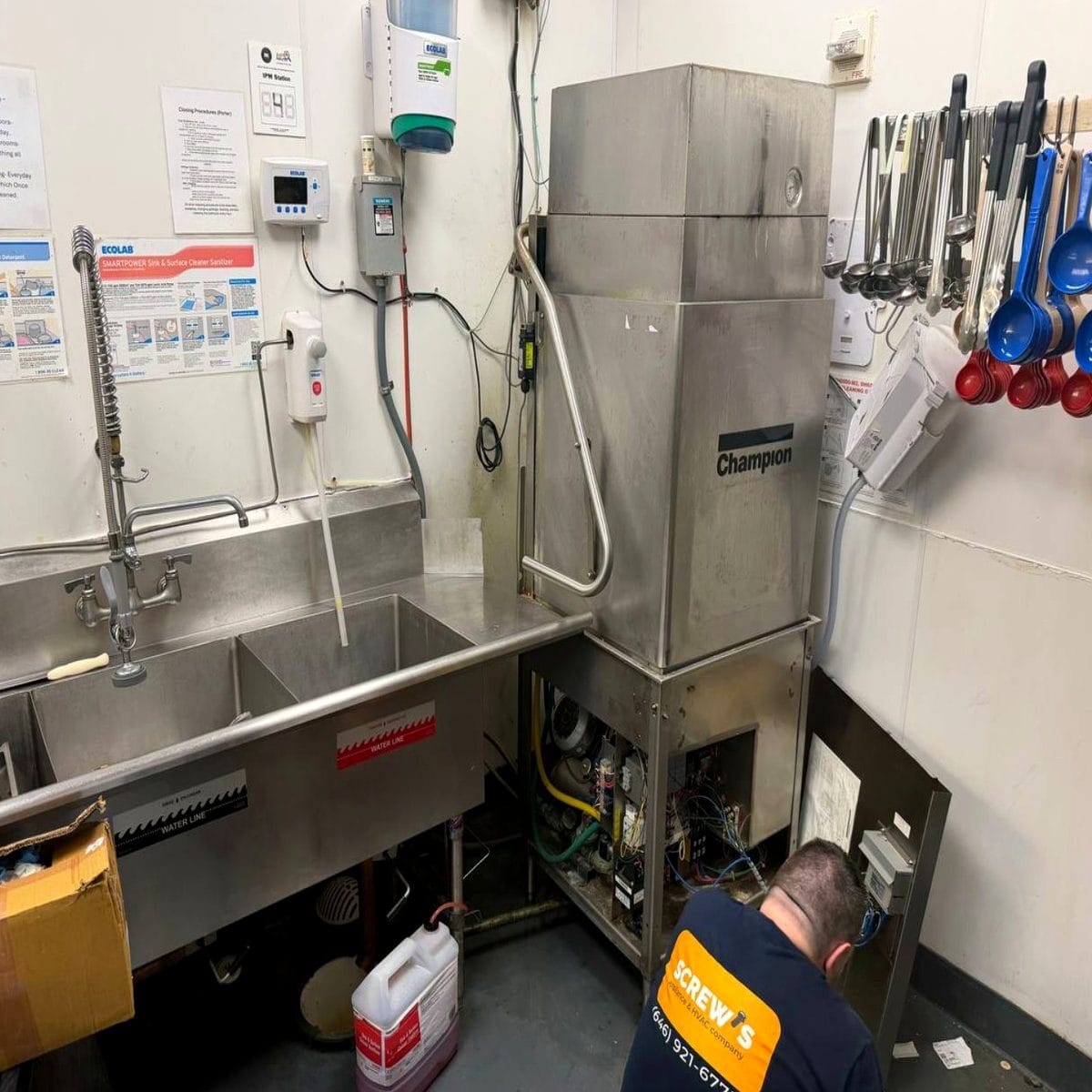
A commercial dishwasher that will not complete its intended drain cycle may have clogged strainers, a restricted drain line, a pump or valve problem, an incorrect water-level signal, or a blockage in the building plumbing. The symptoms can look similar, but the repairs are different.
Before assuming something is broken, check whether your model should actually be empty at that point. Water remaining in the wash tank between racks is normal on many commercial dishwashers. Other machines use fill-and-dump operation. The exact model and operating stage matter.
This guide helps restaurant staff distinguish normal operation from a drainage problem, make limited operator-level checks, and prepare useful information for a service visit. It is not a substitute for the machine’s operating manual.
First, Confirm Whether the Dishwasher Should Be Draining
Commercial dishwashers do not all empty the wash tank after every rack. Tank-type machines can retain heated wash water and discharge only part of it during operation. A separate drain or shutdown program empties the tank when required. Fill-and-dump machines follow a different sequence.
Check the operator manual before treating a full tank as a fault. Is the machine between racks, running its drain program, or already shut down? If the water level remains abnormally high after the specified drain procedure, drainage is unusually slow, or a fault message appears, investigate further.
Also distinguish failure to drain from failure to hold water. A machine that fills and immediately loses water has a different problem from one that retains water after a drain command.
Seven Areas to Check When a Commercial Dishwasher Will Not Drain
The following categories are a troubleshooting framework, not a ranking of failure rates. Not every machine has a separate drain pump, an automatic drain valve, or the same type of level sensor.
1. Clogged Strainers, Filters, or the Drain Area
Food scraps, labels, napkins, and broken glass can restrict the drain path. Removable strainers and scrap baskets can also become overloaded, allowing debris to collect around the drain opening.
Look for slow drainage or water remaining above its normal level after the intended drain cycle. Once the machine is safely shut down and the water has cooled, clean only the parts identified as operator-removable in its manual. Keep debris out of the drain rather than pushing it farther inside.
Do not reach blindly into standing water or a drain opening: sharp objects may be hidden. If you cannot safely see or access the obstruction, leave it for a technician.
2. A Restricted Drain Hose or Waste Line
Where a drain hose is fitted, it may be kinked behind the machine, crushed by stored items, or obstructed internally. Fixed waste piping can also become restricted. An installation problem should be considered if drainage became unreliable after the machine was moved or replaced.
Visually inspect accessible hose sections for kinks, damage, and leaks. A hose that looks clear outside can still be blocked inside. Do not disconnect plumbing, pull a connected machine out, or change the drain routing as a casual troubleshooting step.
Drain height and routing must match the machine’s installation instructions. There is no single hose arrangement that works for every commercial dishwasher.
3. Drain Pump Problems — on Machines Equipped With One
A blocked impeller, damaged pump component, seized motor, wiring problem, or missing control signal can prevent a pumped-drain machine from removing water. Humming, grinding, or a pump that appears to run without moving water are useful observations, not proof that the pump must be replaced.
Do not open the pump housing or attempt live electrical tests. Record whether the noise happens during washing or during the actual drain program; the wash pump and drain pump may be separate components.
4. Drain Valve or Drain-Assembly Problems
On a machine that uses a drain valve, debris or a failed actuator can prevent the valve from opening. Some models also use an operator-removable standpipe or overflow component as part of their drain arrangement. Follow the exact model’s instructions before removing or repositioning it.
A valve that stays closed can prevent drainage. A valve that fails to close can prevent the tank from retaining water. These are different faults and should not be confused with dirty water returning from the building drain.
Do not force a valve, bypass its mechanism, or remove components that require service access. A technician should check the assembly and its control signal.
5. Water-Level Sensor or Pressure-Sensing Problems
On electronically monitored machines, an incorrect level signal can make the control respond as though the tank is still too full. Possible causes include contamination, a problem with the sensing tube or air trap, a failed sensor, or a wiring fault.
If water has visibly drained but the warning remains, report both facts. Do not assume a sensor has failed until the actual drain performance has been checked. Note excessive foam and confirm that approved commercial chemicals are being used; leave sensing tubes and electrical connections untouched.
6. A Blocked Building Drain or Waste Receptor
The dishwasher may discharge correctly while the floor sink or other waste receptor cannot accept the flow. Warning signs include water rising in the receptor, nearby sinks draining slowly, or more than one fixture backing up.
Check accessible areas visually and report the condition to the building contact. Do not open waste lines or grease-handling equipment. A plumber or drain-service company may be needed alongside the appliance technician. A grease interceptor is relevant only where it forms part of the affected drainage system.
7. Control, Wiring, or Interlock Faults
If the drain sequence never starts, stops unexpectedly, or repeatedly produces a control warning, the fault may involve wiring, a relay, an interlock, or the control system. Do not conclude that the main board needs replacement based on a symptom alone.
Follow one operator-approved restart only when the manual permits it and there is no leak, electrical warning, or other unsafe condition. A recurring fault requires diagnosis, not repeated resets. Do not open electrical panels or bypass safety switches.
What a Drain Error Code Does — and Does Not — Tell You
An error message identifies a condition the control has detected; it does not necessarily identify the failed part. A drain warning can result from restricted flow, a pump problem, or an incorrect water-level reading. Use the code table for the exact manufacturer and model, and record the full message before any approved restart.
For example, Hobart’s LXn support documentation lists both drainage components and tank-pressure sensing among the checks for a drain-system fault. That is why a warning mentioning drainage is not, by itself, a reason to order a pump.
Safe Checks Before Calling for Service
If there are no emergency conditions, use this short sequence. Only trained operators should carry out maintenance tasks permitted by the manufacturer.
- Record the machine and symptom: photograph the data plate and display. Note whether the problem occurs during a rack cycle, a dedicated drain program, or shutdown.
- Confirm the correct drain procedure: do not interrupt a normal shutdown sequence or assume that pressing a power button briefly will empty every model.
- Prepare safely for cleaning: follow the manual’s shutdown and electrical-isolation instructions. Allow hot water and surfaces to cool. Do not handle internal parts while equipment is energized.
- Clean operator-accessible parts: empty strainers and scrap baskets, and inspect the visible drain area without dismantling pumps or valves.
- Inspect the surroundings: check visible hoses, the waste receptor, and nearby fixtures. Report leaks, backups, or unusual foam.
- Reassemble and retest only as instructed: refit all removed parts correctly. If the fault returns or the intended drain cycle still fails, stop troubleshooting and arrange service.
When to Stop Using the Machine
Take the dishwasher out of service if an actual drain failure persists, it overflows, wastewater backs up, water reaches electrical components, or the machine cannot complete the required cleaning and sanitizing process. Severe grinding, a burning smell, sparks, or a tripping breaker also require prompt attention.
Do not repeatedly reset a breaker or operate switches from a wet area. Keep staff clear of leaks and electrical hazards, and have a qualified person isolate the equipment safely. Normal retained wash water between racks is not, on its own, a reason to shut down a tank-type machine.
NYC Drain Connections: When a Plumber Is Needed
NYC Plumbing Code Section 802.1.7 specifies an indirect discharge to a waste receptor through an air gap or air break. The appropriate installation must also satisfy the machine instructions and applicable code provisions. This is a plumbing requirement, not a universal instruction to add a household-style air-gap fitting. [5]
If the receiving drain overflows, several fixtures back up, or the connection appears incorrectly installed, involve the building manager and a qualified plumber. An appliance repair alone may not resolve a downstream plumbing problem.
Maintenance That Helps Reduce Drain Problems
During service: Remove food scraps before loading racks. Keep strainers fitted correctly and inspect them at the intervals required for the workload and model.
At shutdown: Follow the specified drain and cleaning procedure. Clean removable filters and scrap baskets, remove visible food debris, inspect for leaks, and reinstall parts correctly.
Periodically: Arrange model-appropriate inspection of drain components and connected plumbing. Set deliming frequency according to the manufacturer, actual water conditions, and observed buildup—not a blanket assumption that every NYC kitchen has hard water. NYC DEP notes that hardness varies with the water supply.
Frequently Asked Questions
Should a commercial dishwasher empty after every rack?
Not necessarily. Some retain wash water between racks, while fill-and-dump machines use a different sequence. Compare what you see with the operating manual, especially the instructions for tank draining and end-of-day shutdown.
Why does it drain slowly even after I clean the strainer?
The restriction may be farther downstream: in a hose, drain assembly, pump, or building waste line. A clean strainer does not prove the whole path is clear. Tell the technician which accessible parts were cleaned and whether nearby drains also respond slowly.
Why does water return after the dishwasher drains?
First check whether the machine is intentionally refilling. If not, a technician should distinguish fresh water entering through a leaking inlet valve from wastewater returning through a drainage problem. A drain valve that stays open usually causes water loss, not automatic backflow from the building.
Can I use ordinary drain cleaner or hand dish soap?
Do not add them to the dishwasher as a drain repair. Use only cleaning products and procedures approved for the exact equipment. Hand dish soap can produce excessive foam, and an unapproved chemical may damage components or create handling hazards.
Is a restart enough to fix a drain error?
A manufacturer-approved restart may clear a temporary fault, but it does not remove a physical blockage or repair a failed component. If the warning returns or drainage remains abnormal, record it and schedule diagnosis.
How much does commercial dishwasher drain repair cost?
The estimate depends on the model, cause, access, parts, and labor. Cleaning an accessible restriction is different from replacing a pump or repairing a building drain. Ask for a diagnosis and an itemized estimate before authorizing repairs.
Commercial Dishwasher Repair in NYC
Screws Appliance Repair provides commercial dishwasher diagnostics, repair, and maintenance for New York City businesses. Equipment includes undercounter and door-type machines, conveyor and flight-type systems, and commercial glasswashers.
Before requesting service, prepare the brand, model, serial number, exact warning, and a photo or short video of the problem. Mention whether the machine fails during its normal drain procedure and whether nearby plumbing is also backing up.
If operator-level checks do not restore normal drainage, schedule commercial dishwasher diagnostics. Learn more about our commercial dishwasher repair in NYC service.