
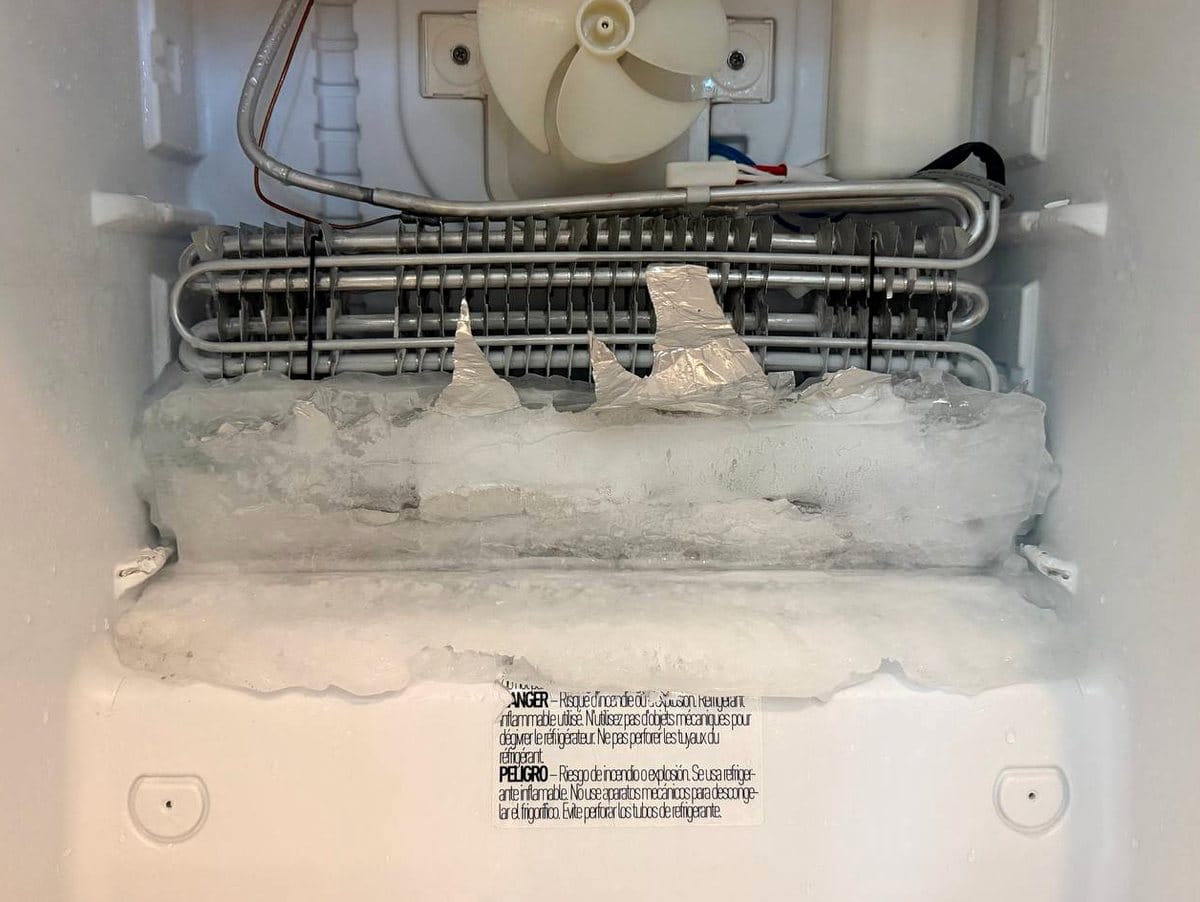
A commercial freezer usually develops frost or ice when moisture enters the cabinet, airflow is restricted, defrosting is incomplete, or defrost water cannot drain correctly. Door seals, loading habits, evaporator fans, and temperature controls can all be involved. The location of the ice is a useful clue, not a diagnosis of a failed part.
For a restaurant manager, the first priorities are protecting the food, checking accessible doors and vents, and recording what has changed. This guide covers seven common problem areas, safe staff checks, and when to arrange professional service. It focuses on commercial freezer cabinets, including reach-in and undercounter equipment; the operating instructions for the exact model take priority.
Is Some Frost Normal in a Commercial Freezer?
It depends on the design. A manual-defrost freezer needs periodic defrosting as part of normal maintenance. An automatic-defrost freezer manages frost through its control system. TRUE identifies several manual-defrost product families in its equipment guide. Recurring frost is not automatically a failed heater or timer.
Heavy ice that blocks vents, interferes with the door, contacts a fan, or accompanies poor temperature control needs attention. Also investigate a change from the freezer’s usual pattern, particularly rapid buildup after a properly completed defrost.
Protect Frozen Stock Before Troubleshooting
Check the cabinet temperature using the establishment’s monitoring procedure, and assess product condition. If the freezer cannot maintain the storage conditions required for its contents, move the stock to functioning equipment. Record the time and temperatures, and have the person responsible for food safety evaluate any thawed or temperature-abused food. Do not decide that food is safe solely because the display looks normal.
Before an operator-approved shutdown or full defrost, arrange alternative frozen storage. Return stock only after the freezer has recovered to its required operating range. Beverage-Air includes food removal, power disconnection, and temperature recovery in its cleaning instructions.
For NYC kitchens, Health Code §81.18 also addresses clear refrigeration airflow, working fans, intact door gaskets, and suitable thermometers. A chilled-food holding limit is not a freezer operating target: use the equipment instructions and the storage requirements of the food.
Seven Common Reasons a Commercial Freezer Is Icing Up
1. Door or Gasket Problems
A damaged or poorly seated gasket can let humid kitchen air enter the freezer even when the door appears closed. Packaging caught in the frame, a sagging door, or worn hardware can prevent a proper seal. Frost may concentrate near the opening, although that pattern does not identify the faulty component by itself.
What staff can check: Inspect accessible gasket surfaces for tears, gaps, dirt, and sections pulled out of place. Remove items preventing closure and clean the sealing surfaces as the operator manual allows. Check whether ice is itself stopping the door from closing.
If the seal remains uneven, arrange inspection of the gasket, alignment, and hardware. Do not force a frozen door or start adjusting hinges without an approved procedure.
2. Frequent Door Opening and Warm Air Infiltration
Every door opening brings warmer air into the cabinet. Extended loading, a door held open during service, and high surrounding humidity can increase the moisture entering the freezer. Loading warm products into equipment intended only to hold already-frozen food can also exceed its intended use.
Check whether icing follows deliveries, restocking, or peak service. Organize stock so staff can retrieve it quickly, avoid propping doors open, and follow the manufacturer’s loading instructions. Screws_NYC_Commercial_Freezer_I…
Frequent access does not prove a mechanical fault. However, continued heavy icing after normal operating practices are restored warrants a closer look at sealing, airflow, and defrost operation.
3. Restricted Airflow
Boxes or containers against air outlets and return passages can disrupt circulation. Heavy ice can then restrict the air path further. Blocked airflow does not create moisture on its own, but it can contribute to poor temperature distribution and worsen an existing icing problem.
Look for blocked visible vents, products packed tightly around the evaporator cover, and loading that exceeds marked limits. Check whether temperature problems are limited to particular shelves or appear after restocking.
Rearrange products within the model’s clearance requirements. There is no universal shelf gap for every commercial freezer. If ice is behind a cover or blocking a concealed passage, document it without removing panels.
4. Defrost System Problems
On automatic-defrost equipment, a fault can prevent frost from being removed effectively. Depending on the design, the problem may involve a heater, controller, timer, termination sensor, wiring, or another model-specific component. Not every freezer uses the same method or schedule.
Clues include progressively thicker frost around the evaporator, declining airflow, and icing that returns unusually quickly after defrosting. These symptoms can also overlap with door and fan problems; they do not establish that a heater needs replacement.
Record alarms and the timing of the buildup. Do not copy a reset sequence from another model or change defrost intervals to mask the fault. Internal testing belongs with a qualified commercial refrigeration technician.
5. Evaporator Fan or Air-Circulation Problems
A failed fan, an obstruction, or ice contacting the blades can disrupt circulation and produce unusual noise. Note whether the sound comes from inside the cabinet, whether temperatures are uneven, and whether the problem changes with the door position.
A fan stopping when the door opens is not, by itself, a fault. On some models, fan operation also depends on compressor operation, defrost, and restart delays. TRUE’s guide describes model-dependent fan cycling.
Never hold down or bypass a safety switch to test a fan, reach through its guard, or try to turn the blades by hand.
Report scraping or grinding promptly instead of allowing the fan to keep striking ice.
6. Temperature Sensor or Control Problems
A sensor, wiring connection, thermostat, or controller fault can interfere with temperature regulation or defrost operation. Possible signs include repeated alarms, unexpected cycling, and a persistent discrepancy between the display and independent monitoring.
Readings taken at different locations or during different operating stages are not directly interchangeable. Record the time, measurement location, displayed value, and any defrost indication rather than assuming that one mismatch proves a bad sensor.
Do not turn the setting to its coldest position as an ice-removal method. For its HBF models, Beverage-Air specifically notes that lowering the setpoint does not make the unit cool faster. Control parameters and calibration should be checked against the exact model’s instructions.
7. Drain or Condensate Problems
Defrosting produces water that must be managed by the equipment’s drainage system. A restricted or frozen drain can allow that water to collect and refreeze. Depending on the design, a drain-related heater or another component may also need inspection. Screws_NYC_Commercial_Freezer_I…
A recurring sheet of ice on the cabinet floor, ice below the evaporator, or buildup that follows defrost can suggest this path. A spill may create a similar pattern, so the location alone does not prove a blocked drain.
Check only accessible areas identified for operator maintenance. Do not push tools into a concealed drain, disconnect tubing, or pour hot water into the unit as an improvised fix. Repeated floor ice needs investigation, not repeated chipping.
Where Is the Ice Forming?
Photograph the pattern before cleaning or defrosting. This table is a reporting aid, not a parts-replacement guide.
| Ice location | What may need checking | Useful information to record |
|---|---|---|
| Door opening or gasket | Closure, gasket contact, humid-air entry | Gaps, damaged sections, prolonged opening |
| Evaporator cover or visible vents | Moisture load, airflow, defrost, fan operation | Blocked vents, noise, alarms, timing |
| Solid ice on the cabinet floor | Defrost-water drainage, refreezing, or a spill | Whether it returns after defrost and where water appears |
| Walls or packaging throughout the cabinet | Door usage, loading, humidity, defrost needs | Recent deliveries, time doors were open, changes in use |
Keep the door open only as long as necessary to document the issue. Do not remove covers to obtain a better photo.
What Restaurant Staff Can Safely Check Before Calling for Service
Keep checks visual and limited to normal operator maintenance. Collect the following information once rather than repeatedly restarting the freezer.
- Check the door. Confirm that racks, packages, or ice are not preventing complete closure.
- Inspect the gasket. Note visible damage, displacement, dirt, and uneven contact. Do not force hardware or pry frozen seals.
- Check accessible air passages. Remove storage obstructions while following the equipment’s load and clearance limits.
- Document the ice. Photograph its location and extent, along with the door seal and any visible alarm.
- Record temperatures. Note the display, independent monitoring results, the time of measurement, and whether products are softening.
- Record the model and serial number. Photograph the data plate, including any refrigerant identification. Do not open a panel just to locate it.
- Note when it started. Record recent restocking, prolonged door opening, cleaning, moving, service, or unusually rapid recurrence after defrosting.
- Use only the approved defrost procedure. Follow the exact model’s operator instructions, protect the stock first, and arrange qualified help when the procedure is not an operator task.
Do not use knives, screwdrivers, heat guns, hair dryers, open flames, or improvised heating methods to remove ice. Do not open electrical enclosures or refrigerant tubing. Some commercial freezers contain flammable refrigerant, so damaging a tube is more serious than damaging a cosmetic panel. Beverage-Air’s HBF safety instructions specifically warn against sharp tools on a frozen evaporator and identify R290 precautions. [2]
For manual cleaning that requires power isolation, follow the manufacturer’s disconnection procedure; a dark display alone is not proof that every component is electrically isolated. Have qualified personnel handle inaccessible or hardwired disconnection. Screws_NYC_Commercial_Freezer_I…
When Should You Call a Commercial Freezer Technician?
Arrange service when ice returns unusually quickly, the door still cannot seal, airflow remains weak, temperatures are not recovering normally, or a fan makes abnormal mechanical noise. Repeated alarms and water refreezing in the same place also justify diagnosis.
If food is no longer being held under the required conditions, stop relying on that freezer for storage and take corrective action. That is separate from deciding how to isolate electrical power safely.
For sparks, burning smells, a damaged cord, or water near electrical components, keep staff clear and follow the site’s emergency procedure. Do not repeatedly reset a tripping breaker or handle wet plugs. Electrical, refrigerant, and internal control testing should be left to qualified personnel.
Why Repeatedly Removing the Ice May Not Solve the Problem
Defrosting removes accumulated ice; it does not repair a leaking gasket, a failed fan, a restricted drain, or a control fault. On an automatic-defrost freezer, repeated unscheduled thawing can hide a continuing problem.
Manual-defrost equipment is different: scheduled defrosting is normal maintenance. The concern is an unusual increase in buildup, loss of temperature control, or recurrence well beyond the unit’s established pattern.
A useful service report is specific: describe where the ice forms, how soon it returns, the temperatures, and any door or fan symptoms. “The freezer needs more refrigerant” is not a conclusion staff should draw from ice alone.
Preventive Maintenance That Helps Reduce Freezer Problems
Daily: Check that doors close, accessible gaskets remain clean and intact, and storage does not block designated air paths. Monitor temperatures and new frost patterns. Record water, ice, alarms, or a change in operating noise.
During loading and service: Keep stock organized, minimize unnecessary door-open time, and follow the unit’s intended loading and product-temperature requirements. Do not use a holding freezer as a substitute for equipment designed for rapid freezing.
Periodically: Follow the manufacturer’s schedule for cleaning, drains, fans, defrost controls, temperature verification, and refrigeration service. Separate tasks assigned to operators from those requiring a technician. A fixed monthly defrost or a universal maintenance interval is not appropriate for every model.
Frequently Asked Questions
Why is my commercial freezer icing up?
Possible causes include humid air entering through the door, poor sealing, loading or airflow problems, incomplete defrosting, fan faults, control problems, or defrost water refreezing. Check the model and where the ice forms before assuming that any specific component has failed.
Why does my commercial freezer keep icing up after I defrost it?
The moisture, airflow, drainage, or defrost problem may still be present. On manual-defrost equipment, some gradual recurrence is expected. Rapid or excessive recurrence, particularly with temperature problems, should be investigated rather than repeatedly treated as a cleaning issue.
Can a bad freezer door gasket cause ice buildup?
Yes. A gap can admit humid air, allowing frost to accumulate on cold surfaces. However, a displaced rack, misaligned door, or damaged hardware may also prevent sealing. Replacing the gasket without checking closure may leave the actual problem unresolved. Screws_NYC_Commercial_Freezer_I…
Should I remove ice from my commercial freezer myself?
Only when the operator manual provides an appropriate procedure and the food can be stored elsewhere if required. Do not chip ice, apply improvised heat, or remove internal panels. Arrange service when safe access or the correct procedure is unclear.
Why is ice forming around the evaporator?
Moisture freezes on the cold evaporator during operation. Excessive accumulation may involve air infiltration, restricted airflow, a fan issue, or incomplete defrosting. A frost pattern alone does not establish a heater, compressor, or refrigerant fault.
Can blocked airflow cause a commercial freezer to ice up?
Restricted circulation can contribute to uneven operation and worsen icing; it is also a consequence of heavy frost. Clear accessible vents according to the loading instructions. Internal obstructions, fans, and evaporator components require further diagnosis if performance does not recover.
Why is my commercial freezer running constantly?
Long operation may follow heavy loading, frequent opening, poor sealing, restricted airflow, or a refrigeration or control problem. Run time alone is not a parts diagnosis. Compare it with the unit’s normal behavior and actual temperatures, and report significant changes.
How much does commercial freezer repair cost?
Cost depends on the model, access, diagnosis, required labor, and parts. A door-sealing correction is different from work on a drain, fan, heater, controller, or refrigeration circuit. An onsite diagnostic visit is generally needed to prepare an accurate repair estimate.
Commercial Freezer Repair in NYC
Screws Appliance Repair provides commercial equipment service for New York City restaurants, bars, cafés, hotels, and other businesses. For persistent ice buildup, request commercial freezer repair in NYC.
When arranging a visit, send the manufacturer, model, serial number, current temperatures, and photos of the ice and display. Include when the problem started, whether it returns after defrosting, and any recent cleaning, loading changes, or repair work.
This information helps prepare for model-specific diagnosis. Protect the stock, limit checks to operato